Pages

Sunday, April 3, 2011

Heartless?

Joel 2_12.jpgI have heard some people say that a Reformed view of Scripture and the Gospel promotes an elitist, heartless, intellectual determinism. Though that can happen, I do not think that it is exclusive to a Reformed understanding of Scripture. Nevertheless, Reformed thinking is what I was thinking about this morning.

As I was driving to church, I was listening to an introduction to the White Horse Inn Discussion Group. They were recounting the inception of the group and the general intent of the group. One particular sound byte that they were talking about was from a show a number of years ago. It was a recording that they took while interviewing a number of professed believers. In the interview, they basically asked the question: can you describe the Gospel? As one might assume the answers were widely varied and every single person interviewed missed the point completely. That of course made the point of those on the panel of the White Horse Discussion Group and they went on.

Some time later, the White Horse Inn members heard about how that particular set of interviews impacted Dr. R. C. Sproul who was, at the time of the original airing, driving in his car. As he listened to people’s understanding, or lack thereof, of the Gospel, he became overwhelmed with sorrow; it was said that he actually had to pull his car to the side of the road as he wept over the lack of understanding that has so permeated Christianity at large. There are few men in Christianity that have such an incredible burden for people to know the truth about the one true God and Savior of men.

I think of my own life and I am shamed by that. In thinking about my past, I can recount breaking down in that type of anguish only over losing a dear friend or relative. I have not yet come to such a point of love for the truth that I weep when people do not comprehend or even care to comprehend it. In many ways, Dr. Sproul’s response almost makes me look like the one  who is heartless.

So then, I would ask: Does the example set by Dr. Sproul demonstrate a heartless, determinism? Have you ever been burdened for God’s truth to such a degree? Instead of criticizing the finer points of his theology, though they probably exist for most of us, let us (myself included) be challenged by his example; why don’t we cultivate the same kind of love for our God and Savior.

Friday, March 25, 2011

Cheapening the Name of Jesus

Over my spring break, I have had the opportunity to read Francis Schaeffer’s Escape from Reason for my Introduction to Philosophy class. I had already had the chance to read How Should We Then Live and thoroughly enjoyed it. I can once again say the same for Escape from Reason. Since I do not have time to post a full review of the book, I would like to share what I believe to be one of the most eye-opening points in the book.

To give a little bit of context, Schaeffer traces the historical progression of Western philosophical thought. His goal is to show why the modern man thinks in the manner he does. Though most people are unaware of their own philosophical views, the general consensus among the modern man amounts to relativism. Thus Schaeffer says,

I have come to the point where, when I hear the word "Jesus"—which means so much to me because of the Person of the historic Jesus and his work—I listen carefully because I have with sorrow become more afraid of the word "Jesus" than almost any other word in the modern world. The word is used as a contentless banner, and our generation is invited to follow it. But there is no rational, scriptural content by which to test it, and thus the word is being used to teach the very opposite things from those which Jesus taught. Men are called to follow the word with highly motivated fervency, and nowhere more than in the new morality which follows the New Theology. It is now Jesus-like to sleep with a girl or a man if she or he needs you. As long as you are trying to be human you are being Jesus-like to sleep with the other person, at the cost, be it noted, of breaking the specific morality which Jesus taught. But to these men this does not matter because that is down-stairs in the area of rational scriptural content.1

It is a scary thing to think about how many people have fashioned a Jesus according to their own liking. It is worse yet to think that Christians are guilty of the same thing by softening the message of the Gospel, feminizing Christ, or simply failing to declare the whole counsel of God (Acts 20:27). It seems as if we are able to slap Jesus’ name on something, it becomes okay. Though I have heard it joked about, there seems to be a “Christianized” version of everything the world comes out with. As a result, Christianity no longer stands for anything; affirming the name of Jesus is cool as long as you have do not have truth to back it. Those are just some thoughts that really hit me as I was reading. I hope that they can remind us all to make sure that our affirmation of Christ really does mean something.

“Now unto him that is able to keep you from falling, and to present you faultless before the presence of his glory with exceeding joy,To the only wise God our Saviour, be glory and majesty, dominion and power, both now and ever. Amen.”
Jude 24–25


1 Schaeffer, Francis. Escape from Reason. (Downers Grove, IL: IVP Books), 
Pgs. 100–101.

Monday, December 27, 2010

God’s Providential Protection

Accident Reconstruction
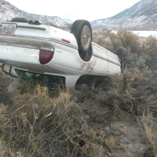
As Graham, Dustin, and I were headed for an epic day on the slopes of Copper Mountain, our plans were altered by an untimely car accident. (1) We were traveling in Graham’s ‘94 Chrysler LHS and had just passed the Dotsero exit on East bound I-70. We were traveling approximately 70-75 mph on the seemingly good roads. (2) We had just started rounding a gentle curve when the rear end of the car started to drift. (3) Before anyone could say anything, we were sliding at full speed across the lanes of the Interstate. (4) As we crossed the left lane and the front tires went off the road, we hit a reflector post and kept sliding. (5) Entering the median, we continued to spin but as our wheels hit the dirt we began to slow more rapidly. (6 & 7) When we had made approximately three-quarters of a revolution, the front, driver’s side tire caught and sent our car into a roll. (8) As we rolled onto the roof of the car, we finished our revolution and slid to a stop once again pointing East.
Once the car came to a stop on its roof, we were all hanging by our seatbelts. After I made sure that I could still move, I called out to see if Dustin and Graham were okay. Thankfully they confirmed that they felt okay aside from the shock we were all experiencing. At that point, I braced myself against the roof of the car, released the seatbelt, and flipped over to find a way out of the car. The rear passenger door seemed to be undamaged so I started checking to see whether it would open at which point it did. After I crawled out, Graham was able to unbuckle and crawl out as well. Dustin was in the most badly damaged area of the car which was the front passenger side. After Graham was free, Dustin finally had enough room to turn over and crawl out. By the time Dustin was on his way out of the car, I had dialed 911. I, of course, gave the details of the wreck and described our location to the best of my ability. Before I got off of the phone, the dispatcher instructed us to stay in the car. OOPS!   =)   If we had waited in the car we would have hung there for 25 minutes before the first EMS personnel arrived.
Once the emergency vehicles arrived, things were pretty standard. We just had to fill out the usual forms and answer the usual questions. Since we had been out of the vehicle for almost 30 minutes when the ambulance arrived, the paramedics didn’t even bother checking us out. We then had to wait for the tow truck driver to load the car. Once the car was loaded, we all piled into the cab of the truck so the driver could drop us off at a small cafĂ© to wait for my parents to come pick us up.
Considering the fact that we were going over 70 mph when we started into the slide, it is truly miraculous that none of us were hurt beyond a couple scratches. There were so many things that could have happened ending any one, or all, of our lives. We truly do have an awesome God that provides for us in every moment of every day. Praise God that we can say with full sincerity, “And we know that all things work together for good to those who love God, to those who are the called according to His purpose . . . For of Him and through Him and to Him are all things, to whom be glory forever. Amen.” (Rom 8:28, 11:36).
Here are a few more pictures of what the car looked like:

Tuesday, December 21, 2010

Living in the Moment

Vintage-StopwatchIt seems that God has brought a recurring truth into my life. That truth is that I need to keep my focus in the here and now. It is too easy to get caught up in thoughts about where my life is headed in the coming years, months, weeks, and even days. That is not to say that planning is a bad thing and it is necessary but it must always be kept in check. In some ways it seems that college is an exaggerated portion of life where I am not really at home while at the same time I have not really begun a life either. That being the case, I tend to look forward to when I am no longer required to go to class, write papers, and meet Christian ministry requirements; I look forward to when I will be able to apply myself to the studying of God’s Word as I am led and to minister as I am needed. Though it is fine for me to anticipate those things, it is important for me to not miss what God has for me right here, right now.

Some months ago now, my church had a guest speaker by the name of Conrad Mbewe. If you are not familiar with him, he is a pastor from Lusaka, Zambia. He has partnered with Ken Turnbull and a number of other Godly men to start African Christian University. I have even heard him called the Spurgeon of Africa and after hearing him preaching, I can understand why. Since Pastor Mbewe has been in the ministry for well over 20 years, I took the opportunity to ask him what advice he had for a young man entering ministry. I will never forget what he told me. He told me to focus on my day-by-day walk with Jesus Christ. It doesn't matter what God has down the road but what God has right now. It was a truly humbling thing for me to hear partly because it is so simple. I so often tend to complicate it by wondering if/when I will go to seminary, if I will pastor a small rural church, if I will end up being a church planter on the other side of the world, and so many other things. Leaving all of those questions unanswered, I must simply conclude that I will live by faith (Gal. 3:11).

Living by faith is a very simple concept yet it is one of the hardest things to practice. In the Sermon on the Mount Jesus said, “Behold the fowls of the air: for they sow not, neither do they reap, nor gather into barns; yet your heavenly Father feedeth them. Are ye not much better than they? Which of you by taking thought can add one cubit unto his stature?” (Matt. 6:26-27). Jesus’ point is that dwelling upon the things of tomorrow will not change anything. I can sit and think about tomorrow for as long as I want to but that will not change that tomorrow will bring what God ordained it to bring. That is why just a few verses later Jesus said, “seek ye first the kingdom of God, and his righteousness; and all these things [temporal goods] shall be added unto you” (Matt. 6:33). When I look to Christ and what He has for me today, I need not worry about what tomorrow may bring.

It is a tremendous comfort for me to know that I do not have to have it all figured out. I must simply be faithful day by day. It is when I am faithful in the little things of today that God can entrust greater things to me tomorrow (Matt. 25:23).

Saturday, November 13, 2010

A Few Thoughts on Humility

I am finally posting on my blog again after a long period of undue neglect. As I was reading in 1 Corinthians 8 this morning, I was struck by verse 2: “And if anyone thinks that he knows anything, he knows nothing yet as he ought to know.” Of course that verse is in the context of knowledge according to the liberty of a mature conscience, however, the principle there goes much deeper. Even in that context, Paul also says, “knowledge puffs up.”

Paul states that the key to possessing knowledge is doing so with a proper view to loving and edifying other believers for in the previous verse Paul says, “Love edifies.” And then a few chapters later, Paul goes on to say, “Love does not parade itself, is not puffed up” (1 Cor. 13:4b). The theme that Paul is emphasizing is love for other brothers and sisters in Christ.

As I thought about those things in the context of college life, it occurred to me how easy it is to allow the knowledge that I acquire here to puff me up. How is it that I, a junior in college, have attained to so great a knowledge of Scripture and theology while other men have devoted their entire lives to such study only to confess their own shortcomings? It is a sobering thought for me especially as I begin to wade into the deep seas of ministry, wondering where in that sea God will have me to go.

It is my hope that the knowledge I gain will never be simply for the sake a placing myself on a pedestal to impress others, but that I may be able to better love, serve, and care for the people of God. It is with the understanding that our knowledge must be used in perspective that we will be truly useful instruments in the hands of God. 

Sunday, June 6, 2010

Surrogates: Pursuit of Illusion

Surrogates_FacebookI just finished a movie entitled “Surrogates” starring Bruce Willis. Upon finishing the movie some thoughts came to me regarding how the movie relates to modern society. If you are not familiar with the movie, the plot centers around a futuristic world of remote controlled machines called surrogates. The surrogates look, sound, and function in the same way that humans do all while allowing the human “operators” to stay in the safety and comfort of their own homes. The story unfolds to show these surrogates implemented en masse transforming the culture into a practically danger-free environment. Overall, it is an intriguing premise but I do not want to go into the finer details of the story. What I would like to do, however, is point out how such an idea is truly the logical end of the extreme Facebook usage so often seen today.

I would like to preface my observations by saying that I do not think Facebook is evil and I doubt one would conclude such a thing after following a link to this post from Facebook. My only purpose is to point out how we must use Facebook in moderation just like anything else. It is an excellent tool to keep in touch with friends that we might otherwise never be able to. That being said, abusing that tool is still a very real danger.

I think what hit home to me when I saw this movie was that the people operating the surrogates were people trying to create and live that ever illusive “perfect life.” The entire idea is based around physically perceived beauty and what the world thinks is attractive. The film portrays a beautiful society filled with perfect looking people while the imperfect operators veiled their true identities. Living such a life leaves no room for true experience, perceiving emotion, or being able to just “be there” for someone. In reality, it leaves no room to see past a person’s imperfections and see them for who they really are. What kind of life is that? The answer is: It’s not. It is an illusion, a virtual or even alternate reality of sorts.

What’s my point? Well, the same can be said for Facebook when it is improperly used. How often do we try to create an image of ourselves, rubbing out or omitting the imperfections? In the past days and weeks I have been considering that very idea as it applies to my own life. I sometimes hesitate to post certain things because I do not want to create a counterfeit image of myself; I do not want to create an affectation of myself. I want to be just as genuine in real life as I am on Facebook or in any other environment.

Though such genuineness does have its personal benefits, it should be noted that the real motive should not be centered on self. Our real motive should be that we are representing Christ. Ephesians 2:6 tells us that God has “made us sit together in heavenly places in Christ Jesus.” It is that truth that demands a genuineness of life. To misrepresent who we are is to misrepresent Christ because we are in Christ. Furthermore, I Corinthians 6:19 asks the question “know ye not that your body is the temple of the Holy Ghost which is in you, which ye have of God, and ye are not your own?” Verse 20 then tells us that we “are bought with a price: therefore glorify God in your body, and in your spirit, which are God's.” To put it succinctly, our body (and how we portray it) is not our own, it is God’s and to misrepresent that is to misrepresent God.

God did not save us because we are perfect. If we were perfect we would not need to be saved. In fact, it is our imperfection and our need for a Savior is something that gives God glory. That being true, we do not need to cover our imperfections but glory in the fact that God can use us in spite of those imperfections. We do not need to put on false airs to impress our friends, we need to put on the genuine lifestyle of who we are in Christ to reach a dying world. May we never get sucked into Satan’s trap of “perceived beauty.”

Please feel free to contribute if you have any further thoughts.

Wednesday, May 19, 2010

Some Perspective on Losing the Ones We Love

arlingtonWhile I was in Hot Springs for the Cornerstone graduation we had a very good time of fellowship which at one point included a time of singing. One of the songs we sang was “It is Well.” The words of that hymn have come to mean a great deal to me as I have learned of the circumstances under which they were written. For those unfamiliar with the story, “It is Well” was written by Horatio Spafford as he dealt with the loss of his 4 daughters. Some sources cite that Spafford had actually lost his son just a few short years earlier. Even so, this man could still say “Whatever my lot, Thou has taught me to say,It is well, it is well, with my soul.”

As we were singing this song, I was thinking about the loss that was felt by Horatio and his wife. From the depths of his grief, Horatio turned to Christ and the truth of His accomplishment on the cross. What a humbling thought. As I just meditated upon these things I began to think about God and specifically how He relates to loss. Hebrews 4:15 tells us that “we have not a high priest which cannot be touched with the feeling of our infirmities; but was in all points tempted like as we are.” This is often related to the fact that Christ was tempted and yet without sin as the verse obviously states, but I believe that it goes further than that. The high priesthood of Christ has to do with compassion for our weakness; it has to do with the sympathy of understanding that can come only by experience. It is a comfort to know that when we struggle with sin and temptation, Christ has struggled in the same way and knows the difficulty of residing in a weak flesh. But what about the times when we are dealing with loss? Does He really know what we are going through? Has He been there? The answer is without question: YES!

To understand the parallels between God and man in feeling loss, we must first articulate the perception of loss. In short, what makes loss so emotionally traumatic is the reality of separation. We cannot bear to lose someone because of the fact that we are separated from them. In our grief it might be easy for us to turn away from God saying “He may understand suffering but He doesn’t know what it’s like to lose someone.” On the contrary, throughout the Bible we see that God has experienced loss and He has experienced it to an extent that we will never know. The greatest example of this is the sacrifice of Christ. Matthew 27:46 says that “Jesus cried with a loud voice, saying, Eli, Eli, lama sabachthani? that is to say, My God, my God, why hast thou forsaken me?” As Jesus hung on the cross, He was separated from the intimate fellowship of the Father because of the sins that He bore. Just as no human is corporeally changed in death, neither was Jesus any less God as He died on the cross. Just as we do not cease to love those whom we lose, neither did God cease to love Christ as He took upon Himself the penalty of our sin. But, just as we are separated from the fellowship of those we love by physical death, so was Christ separated from the Father as the sins of men were laid upon His shoulders. Isaiah 53:5 tells us that Christ “was wounded for our transgressions, he was bruised for our iniquities.” It was because Jesus bore our sins that He was separated from God the Father; His fellowship with the Father had been severed by the weight of sin.

Have you ever considered what Christ’s sacrifice truly encompasses? The physical aspect of Christ’s suffering is enough to make us quiver but what about His loss of fellowship with God? The intimacy of the relationship between God the Father and Christ goes so much deeper than anything a human has ever known, yet God still allowed it to be broken. Severance from the presence of God was part of the punishment that Christ had to bear for our sin; it is a part of what makes sin so horrible. So, just as we experience the severance of a relationship as a result of death, so God’s relationship with His Son was broken by the weight of our sin upon Him. He experienced that loss so that our losses can be restored. When we lose someone dear to us, we can have a confidence in knowing that our Lord knows what we are going through because He has experienced a loss far greater: being severed from the presence of God. It is because Christ was forsaken that we never will be.

As we see our own losses in light of the cross, they pale in comparison. As believers, we will never have to know what severance from the presence of God is like; we will never have to know more than temporal separation; we will always have that intimate relationship with Christ. Jesus Christ knew the ultimate loss so that we would never have to. To me, that puts it into perspective.